
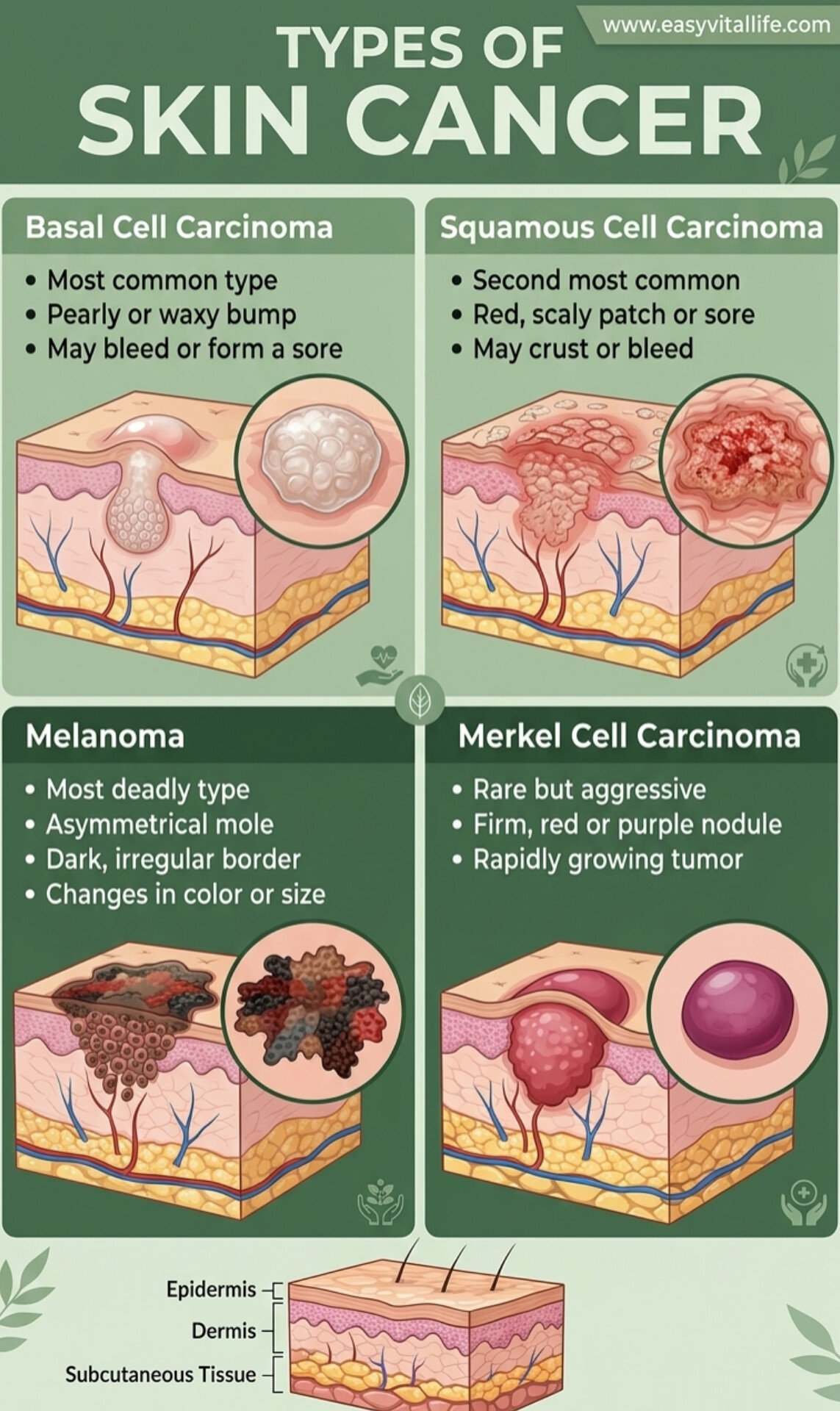
Skin cancer is the most commonly diagnosed cancer in the world. Every year, millions of new cases are identified across all skin types, ages, and backgrounds yet despite its prevalence, a large number of people still cannot identify the early warning signs… that make the difference between a simple outpatient procedure and a life-threatening diagnosis. Knowledge is your first and most powerful line of defense. Understanding the four main types of skin cancer, what they look like, and how they behave can quite literally save your life.
How Skin Cancer Develops
The skin is the body’s largest organ, made up of three primary layers: the epidermis on the surface, the dermis beneath it, and the subcutaneous tissue at its base. Skin cancer develops when cells within one of these layers accumulate DNA damage most commonly caused by ultraviolet radiation from the sun or tanning beds and begin to multiply in an uncontrolled, abnormal way. Depending on which type of skin cell is affected, and in which layer the damage originates, a different type of cancer develops with its own distinct appearance, behavior, and level of danger.
Early detection remains the single most effective factor in successful treatment outcomes for every type of skin cancer. This is why recognizing the visual and physical characteristics of each type is so critically important.
Basal Cell Carcinoma : The Most Common Type
Basal cell carcinoma, commonly abbreviated as BCC, is the most frequently diagnosed form of skin cancer worldwide. It originates in the basal cells, which are found in the deepest layer of the epidermis and are responsible for producing new skin cells as older ones shed from the surface. Because these cells are in constant contact with the basement membrane of the skin, chronic UV exposure over many years causes cumulative DNA damage that eventually triggers abnormal cell growth.
Basal cell carcinoma typically appears as a pearly or waxy bump on sun-exposed areas of the body most often the face, neck, ears, and hands. It may also present as a flat, flesh-colored or slightly pink scar-like lesion that is easy to dismiss as a minor skin irregularity. Over time, the lesion may bleed, develop a central depression, form an open sore that heals and then reopens, or develop a crusted surface.
The reassuring aspect of basal cell carcinoma is that it is rarely life-threatening when caught early. It grows slowly and almost never spreads to distant parts of the body. However, if left untreated, it can grow deep into surrounding tissues, causing significant local destruction, disfigurement, and in rare cases, invasion into nerves and bone. Annual skin checks and prompt evaluation of any unusual skin changes are essential for catching BCC in its most treatable stage.
Squamous Cell Carcinoma : The Second Most Common Type
Squamous cell carcinoma, or SCC, develops from the squamous cells that make up the middle and outer layers of the skin. It is the second most common form of skin cancer and is also strongly associated with cumulative UV exposure, though it can also arise in areas not regularly exposed to the sun, including inside the mouth, on the lips, and in the genital region.
SCC typically presents as a firm red nodule, a rough scaly patch that may itch or burn, a new sore or raised area on an existing scar, or a wart-like growth. The lesion may crust, bleed, or form an open sore that fails to heal properly over several weeks. It is most commonly found on the face, ears, neck, lips, and the backs of the hands.
Unlike basal cell carcinoma, squamous cell carcinoma carries a higher risk of spreading to nearby lymph nodes and distant organs if not treated promptly. Individuals with weakened immune systems, those who have had organ transplants, or people with prolonged exposure to certain carcinogens face elevated risk. Early diagnosis and treatment which typically involves surgical excision, Mohs surgery, or radiation therapy result in excellent outcomes in the vast majority of cases.
Melanoma : The Most Dangerous Type
Melanoma is the most serious and potentially deadly form of skin cancer. While it accounts for a smaller percentage of total skin cancer diagnoses, it is responsible for the overwhelming majority of skin cancer deaths. Melanoma develops in the melanocytes the pigment-producing cells located in the epidermis — and its defining danger lies in its aggressive tendency to metastasize, spreading rapidly through the lymphatic system and bloodstream to distant organs including the lungs, liver, brain, and bones.
Melanoma is identified using the widely taught ABCDE rule: Asymmetry, where one half of a mole does not match the other; Border irregularity, where the edges are ragged, notched, or blurred rather than smooth and defined; Color variation, where the lesion contains multiple shades of brown, black, red, white, or blue within the same growth; Diameter larger than six millimeters, roughly the size of a pencil eraser; and Evolution, meaning any mole that is visibly changing in size, shape, color, or elevation, or that begins to bleed, itch, or crust.
Because melanoma can spread so aggressively, early detection is absolutely critical. A melanoma caught in its earliest stage has a five-year survival rate of over 98 percent. Once it has spread to distant organs, that rate drops dramatically. Monthly self-examinations of the entire skin surface, combined with annual professional skin checks, are non-negotiable for anyone with a history of significant sun exposure, a personal or family history of melanoma, or a large number of moles.
Merkel Cell Carcinoma : Rare but Aggressive
Merkel cell carcinoma is the least common of the four major skin cancer types, but it is also one of the most aggressive. It develops from Merkel cells, which are specialized touch-receptor cells found at the base of the epidermis near nerve endings. Although rare, Merkel cell carcinoma has a high rate of recurrence and a significant tendency to spread quickly to regional lymph nodes and distant organs.
It typically appears as a firm, painless nodule that is red, pink, or purple in color and grows rapidly over a period of weeks to months. It is most often found on sun-exposed areas of the head, neck, and face, and occurs most frequently in elderly individuals and those with significantly compromised immune systems, including people living with HIV or those receiving immunosuppressive therapy following organ transplantation.
Treatment typically involves a combination of surgery, radiation therapy, and increasingly, immunotherapy — which has shown remarkable results in recent years, dramatically improving outcomes for patients with advanced disease.
Protecting Your Skin: Prevention and Early Detection
The most powerful tool against all types of skin cancer is a combination of consistent sun protection and regular skin monitoring. Apply a broad-spectrum sunscreen with SPF 30 or higher every single day not just at the beach, but every time you go outdoors, year-round. Seek shade during peak UV hours between 10 AM and 4 PM. Wear protective clothing, wide-brimmed hats, and UV-blocking sunglasses. Avoid tanning beds entirely the evidence linking them to both melanoma and non-melanoma skin cancers is overwhelming and conclusive.
Perform a full-body skin self-examination once a month, using a mirror to check areas that are difficult to see. Look for any new growths, any existing spot that is changing, and any sore that is not healing. When in doubt, see a dermatologist immediately. No appointment is ever wasted when skin cancer is the concern being investigated.
The Bottom Line
Skin cancer is common, but it is also among the most preventable and most treatable cancers when detected early. Whether it is the slow-growing basal cell carcinoma, the locally aggressive squamous cell carcinoma, the life-threatening melanoma, or the rare and rapid Merkel cell carcinoma every single type responds best to treatment when caught at its earliest stage.
Protect your skin daily. Check it monthly. See a professional annually. Your skin is with you for life treat it accordingly.
Eat smart. Live better. — easyvitallife.com